One day this month (Saturday 24th February 2018), we hit an all time record – 23,296 steps, all around Seville! This equated to 16.6km, or 10.3 miles and resulted in swollen sore feet, aching knees and a desire to return for more.
Ole, Seville….

Seville is such a colourful city and so large and spacious that we hardly covered all of it, in fact we are planning a return trip to visit the historic buildings that we didn’t have time to go into. We took a guided tour of the main areas and learned all about Christopher Columbus (yes, really…..a Spanish guide who liked to talk about the intrepid explorer) and the reason for so many beautiful diverse buildings – the influence of the Phoenecians, the Moors, the Romans, the Arabs and finally the Christians..
The streets were wider than usual allowing for pedestrians, cyclists and trams to blend together, the pavements are clean and colourful, the monuments well maintained, the bars and restaurants were enticing and the people seemed to be very chilled and relaxed, and so well dressed, we felt like we were expecting everyone to head off to a wedding or a celebrity birthday party.

All this resulted from the Ibero-American Exposition of 1929, a world fair held in Seville from 9 May 1929 until 21 June 1930. The purpose of the exposition was to improve relations between Spain and the countries in attendance, all of which have historical ties with Spain through colonization (parts of Spanish America and the United States) or political union. To accomodate all the important guests an impressive hotel was built and named after the current King of Spain, King Alfonso XIII, located in the town square within walking distance of the Cathedral and Fort; each country built it’s own “Pavilion” so the 19 years of preparation created palacial size new buildings many of which became foreign Consulates after the Expo. By far the most impressive of the Spanish buildings is the Hotel Alfonso XIII, next to the university. This was built as a palace to accommodate that king’s family and important guests at the Expo. Refurbished in 2011/2012, the five-star hotel has grand roomss with beautiful tiles, classic contemporary and antique furniture, and all mod cons one would expect of a high class hotel; it is said that Madonna and ‘one of her husbands’ spent a month in the Royal Suite for her honeymoon at a rate of 6,000 per night.
Spain itself built a number of pavilions, many of which mixed Mudejar style, very fashionable at the time, with Art Deco and Regionalism. The most famous one of these is the massive Plaza de España, designed as the Pabellon de Andalucia, (Pavilion of Andalucia) inside the park itself, and the masterpiece of the Expo. With its red bricks, towers and ceramics, it is a typically Spanish building, though on a far grander scale than other monuments of the time. Each region of Spain was represented by ceramic seating areas outside on the ground level.
Seville also held another Expo in 1992, the same year as the Barcelona Olympics. This time around, the theme was the “Age of Discovery” to showcase progress to the 1980’s and to celebrate the 500th anniversary of the discovery of the Americas by Christopher Columbus (1492-1992). The expo was to be jointly held with the City of Chicago, however, due to national, state, and local funding difficulties, Chicago did not accept the offer. The site was based outside the city in an area that is now a research and development park, and a fantasy theme park open to the public. The impressive “pavilions” were again built by participating countries but this time they were temporary structures removed at the end of the Expo.
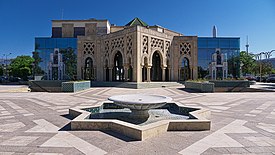 LEFT IS THE MOROCCAN PAVILION AND RIGHT IS THE JAPANESE PAVILION
Below are some photos that showcase the city’s splendour.
The Largest Cathedral In The World:
The immense Cathedral has so many different exterior views. Built in the early 16th century, Seville Cathedral is the largest Cathedral and the third-largest church in the world as well as the largest Gothic church with a total area of 23,500 square meters. The Gothic section alone has a length of 126 meters, a width of 83 meters and its maximum height in the center of the transept is 37 meters. The total height of the Giralda tower from the ground to the weather vane is 96 meters. Since the world’s two largest churches (the Basilica of the National Shrine of Our Lady of Aparecida and St. Peter’s Basilica) are not the seats of bishops, Seville Cathedral is still the largest cathedral in the world. It has 8 different entrance doors and inside are 80 chapels…….no we have not been in each one!!!


The Giralda Tower in Mudejar style is to the right.

The Giralda Tower is a remaining part of the original Mosque that was on the site, 1100 – 1400 approx. .

The interior Gothic features were added between 1430 and 1510.
General Palaces and Buildings:

The side of the City’s Town Hall.

This building was originally a tobacco rolling factory but is now home to the University.

The Gold Tower so called as the sun shines on it’s yellow tiled dome making it look like gold.

Palacio de San Telmo.

The back of the Palacio del Telmo.

The huge frontage…..

Different building styles in the town.


 Hotel Alfonso XIII


 Hotel Alfonso XIII

 Plaza Espana – built for the 1929 Expo


A little Venice in Spain!!

Birds eye view to the right.


 ‘,
‘,
Leave a Reply