It was recommended that we visited this City, and I can see why….as you have probably gathered, we have a fascination with buildings, their style, age and decor. We were in our element here, as the facades were stunningly elaborate.
According to tradition, the city was founded by Hercules in Phoenician times, it became a Roman fishing port, was taken over by the Romans, the Moors and taken back by the Spanish. Phillip II dispatched the Spanish Armada from here to attack the British in 1588, they were defeated, however, the Spanish Armada did defeat the army of Sir Francis Drake later. The population and economy improved and the city soon became a thriving fishing location, a port and a centre for clothing manufacture (Zara fashion clothing company was created here).
Hercules Tower (Lighthouse)
It was a rainy day when we visited, so we stuck to a few of the main attractions: the Tower of Hercules (light house); the castle (now an archeological museum) and the main square surrounded by the Palace and church.
The legend is that Hercules defeated a giant (King of local areas) called Gerion; he buried Gerions head and built a tower on top, founding the city nearby which he named Crunia. When Hercules left, his nephew finished the tower and furnished it with a lamp with fire that was never allowed to go out, placing a large mirror nearby through which enemy ships could be seen.
The original lighthouse was built by the Romans in the first century, the remains of which lay in the basement; also on display was the original stone which held the oil originally used to warn sailors of the rocks below. The building was rebuilt several times, the last major upgrade was in 1788 when an outer wall was added encasing the Chambers inside, making it the Oldest Active Lighthouse in the World. We climbed the 245 steps to the top and despite the drizzle, the view over the town, the coast and the Port was interesting.
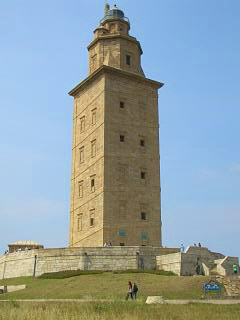
The lighthouse stands on an elevated headland a short distance from the center of A Coruna city, facing the Atlantic Ocean and standing approximately 57 metres (over 180 feet) high.
The two people in the photo to the right give an indication as to the towers enormous size.
Modern Day Hercules!


The Castelo De San Anton (Archeological & Historical Museum)
On the site of the current castle, a chapel was built that was used to quarantine those arriving into the port with “the Fire of San Anton” disease, the chapel was later dedicated to this saint. The building was started in 1588 by King Philippe II and finally completed in 1776 when the Governors house was added to the top floor, and the building then became an active barracks, then a prison right up to 1958 when it was taken over by the local council and turned into the museum that it is today. The irregular shaped building is relatively small but houses interesting artifacts from around the area, including Roman coins and jewellery, a selection of pistols and rifles from 1800s and swords and other items rescued from the sea.
The water storage vault was interesting, water dripped into a storage tank from the stones above, to be used throughout the castle. Not sure I would have drunk it!!

A model of the castle.

View towards the mouth of the port.

View towards the city, the white building is a hospital. Downstairs is the old parade ground.

The water storage tank.

The Governor’s Chapel.

The old fireplace in the kitchen, items in front are old cannon balls.


Galerias
A galeria is nothing more than a balcony, but one that is enclosed in a glass frame protecting it from Galicia’s cool winters and making it usable all year round. Galerias can appear at first floor level, or on the six floor of a six storey building and there are many variances on the basic design.
Galerias are so prevalent and significant in A Coruna for two reasons – firstly, unlike Galicia’s other provincial capitols, a large part of the city is “modernist” and was built in the late nineteenth and early twentieth centuries the galeria design was especially popular during this period. Secondly, the original fisherman’s houses (that lined the harbour and port) were built with galerias and subsequent structures that replaced, or were added to them continued this style.
The harbour front area of “Marina Avenue” is often called the “glass city” or “crystal city”. This is the spot where the original fishermen’s houses were, but today most of this area contains multi-storey offices and apartment blocks all of which are “loaded” with galerias. On a clear day, when the sun faces the harbour front during the evening, the reflection can be blinding and provides an impressive spectacle.
Maria Pita Square has standard shop and business premises at ground level but every possible style of galeria above. The whole area has a feel and atmosphere that is totally different to anywhere else we have visited in Galicia. At first many of the galerias appear very similar to one another, but on a closer look, subtle differences are obvious. Many buildings alternate two or three levels of galeria with an open balcony, or place the galerias only the top floors of the building, some have intricate detailing at sill level, whilst others are supported on ornate sculptured masonry or wrought ironwork there is no fixed style.

The marina front.
Leading to the Maria Pita Plaza


Maria Pita Square, Palacio Municipal & Church de San Jorge
The square is named after Maria Pita, a local who gained notoriety as a heroine by helping reduce casualties when Sir Francis Drake’s attacked A Coruna in 1589 – the square gives the impression that you are walking into a Royal court. 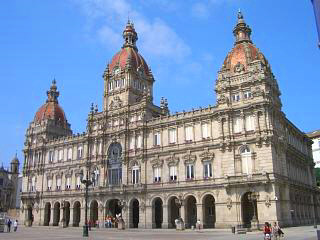 This impression is further enhanced by the Town Hall and Council building (Palacio Municipal) which is truly monumental in both its scale and incredibly ornate detailing, the three domed towers at its front are topped with what appears to be bronze making it glisten in the sun. This building also has a long colonnaded archway along its main frontage and it completely dominates the large square. Its appearance suggests it is an old building, it was actually built in the early 20th century and is less than 100 years old.


San Jorge Church was a return to the opulence seen in most Spanish churches, it was beautiful, still, calm and smelling of lilies and polish.


‘,
Leave a Reply