Travel stories of a caravan duo, plus a 5th Wheel and Isuzu truck in Europe

Category: General (Page 29 of 37)

Seville’s Annual Fair (Feria)

Two weeks after Semana Santa (Easter week) major Spanish cities celebrate the coming of spring with a massive celebratory fair called a Feria and we had the opportunity to visit this in Seville. Generally held over a week, individuals and companies hire “casetas” (translated as small houses but to us they are marquees) and parade in their finest Spanish flamenco outfits and show off their horse and carriages before sitting down to an afternoon and evening of food, drink, song and dancing. The vast area is specifically sectioned off from the town, traffic is diverted and businesses close for the week. The festivities begin just after midnight on Monday with a huge funfair and the local Mayor or dignatory opening proceedings; casetas open from midday each day and remain open until the early hours of the next morning every day, finishing the Saturday night at midnight with a huge firework display announcing the closure of the feria. Gateways are specifically built to signal the entrance to the feria, sadly we did not get to see them lit up at night.

Tradition says the more horses that pull your carriage, the higher up the social scale you are; liveried drivers are dressed to match the carriage and horses are prettied, primped and primed to look their very best. Horses are checked before entering the area, water troughs are abundant and horse “security” men tour each road ensuring the horses are well looked after and not mistreated. Carriages tour the streets before the drivers drop the occupants off outside their casetas, crossroads become a busy junction where carriages and horseback riders cross in front of each other before heading up another street to parade. Individual families also show off their horsemanship by riding solo, ladies are always riding side saddle and horses are just as smartly dressed as those pulling carriages.

The casetas themselves are impressive; we learned that individuals take out “Feria loans” to pay for this event! Some are simply one width (approx.. 8m wide) all are the same depth, dressed internally as though they are hosting a wedding; food and drink areas are at the back, and there is often a stage midway down where dancing takes place later in the evening. Companies and societies often have huge casetas, up to 200m wide with tables and chairs, bar and catering for hundreds of people. All are dressed differently, some with themes and some simply with flowers, tables and chairs.

A funfair is also attached to the Feria, with so many stalls, rides, games and children’s rides that it beats the biggest British funfair I have ever been to! We took a ride in one of the two ferris wheels to appreciate the size of the whole event, impressive beyond words!

The atmosphere was also something that we cannot describe; in the UK we have nothing that compares with this event. Royal Ascot is similar in size and tradition but the feria is much more personal as well as it being a community affair. The only noise is the wooden wheels on the cobbled streets, laughter, greetings, horses, children and the shouts and screams from funfair rides; smells are of sweaty horses, food, drink and the funfair.however, everyone has a great time regardless of age.

Pictures next!

Feria Entrance Gates

Colourful Casetas

Fancy Frillies – Young and Old!

View from the Ferris Wheel

Classy Carriages & Their Contents

 ‘,

Speechless in Cordoba

The city of Cordoba is inland, an hour’s drive east of Seville and as we found out, well worth the drive there. It’s such a pretty city, very old, full of charm and history, not particularly full of tourists so very calm and unflustered. As we approached the city we had driven through lush green hills and agricultural plains before dropping down to this compact city, over a river bridge and into the most lovely city we have been to in a long time.

History here dates back to over 4000 years ago, Roman evidence and ruins are still being uncovered and preserved. The main city comprises a compact Jewish quarter, heaving with narrow white alleyways, small businesses and traditional houses; north of the city is a more modern area full of green plazas, squares and parks and the edge of the city houses small tasteful apartment blocks that blend so well with the surroundings.

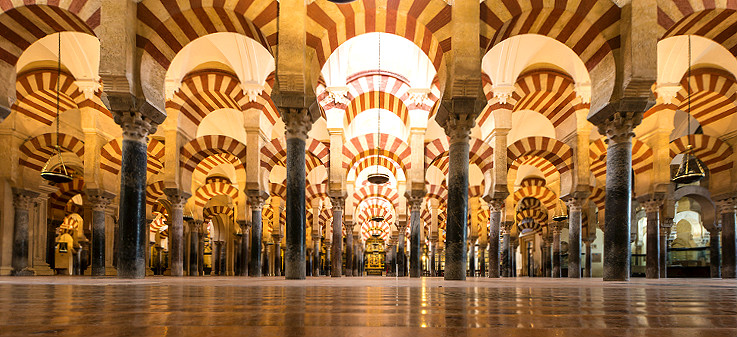
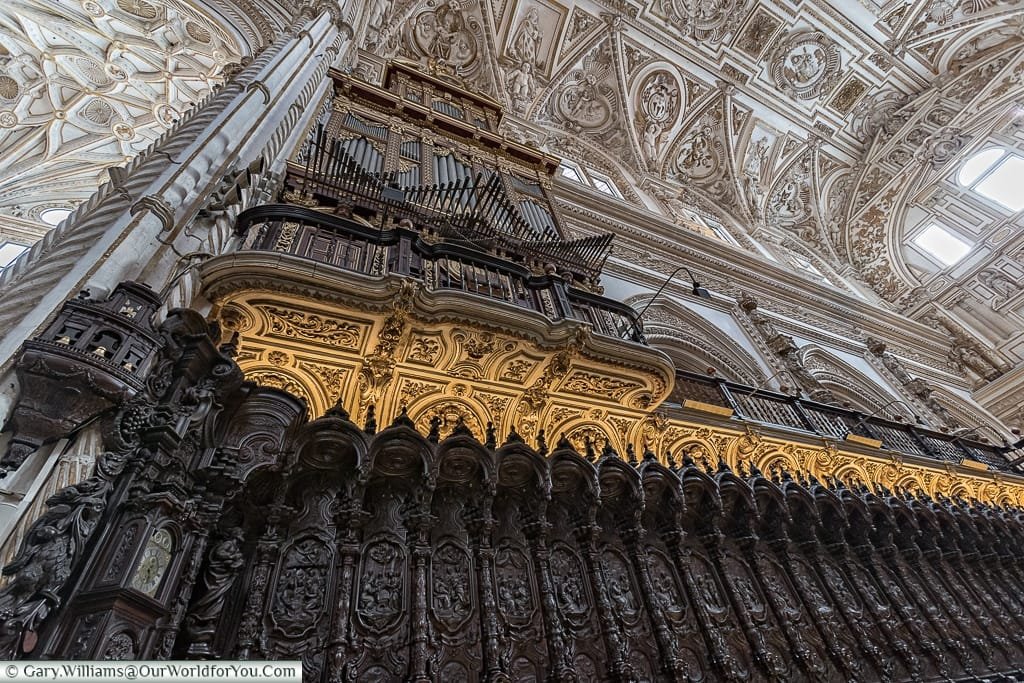
We literally had 36 hours to explore the city and so we did our best; we got lost in the Jewish Quarter several times; visited the Royal Palace and it’s beautiful gardens; explored the 12 patios of Viana Palace (a house that was inhabited by various families up to recent years); wondered at the remaining pillars of the Roman palace; wandered across the Roman river bridge and walked the edge of the city walls. However what really took our breath away was the Mezquita, originally a Mosque that was extended several times before being taken over by the Christians who added a superb Cathedral right in the middle of it. The architecture was stunning, the difference in builders over the years obvious and the eventual result is absolutely breahtaking.

We took a night tour of the Mezquita, which gave the building an eerie atmosphere but brilliantly showed off the sheer size of the building and showed what can be done with imagination and money. Originally built in the 8th century to accommodate people for prayer, it was extended three more times to finally accommodate 24,000 square meters containing 856 columns made of marble, granite, jasper and other materials. Then in 1236 Cordoba was recaptured by King Ferdinand III who rejoined Christendom and the mosque became used as church. Within the Mezquita’s centre, a Renaissance cathedral was built by Bishop Alonso Manrique in 1523. The new cathedral’s construction lasted until the beginning of the 17th century resulting in a remarkable and dazzling symbol of fine Moorish architecture.

City Walls & Jewish Quarter

Roman RemainsThe Alcazar (Palace) of the Christian Kings

Mosaics found on the Chapel walls

View of the River and Roman BridgeMezquita Walls & At Night

Inside the Mezquita

Image result for cordoba mezquita

Image result for cordoba mezquita

Image result for cordoba mezquita

Image result for cordoba mezquita

Related image

Image result for cordoba mezquita

Image result for cordoba mezquita

Image result for cordoba mezquita

Patios Open to the Public

The Viana Palace

‘,

Rio Tinto & Bella Vista

We took a drive north to a fascinating mining museum said to be the oldest in the world and spent the whole day exploring the mine and the area affected by it. The sheer size of the area mined was unimagineable; the ravaged and unrepairable landscape was shocking; the history and technology was fascinating but the overall image was of devastation, despite it once being a thriving community and business. We can honestly say this was an awe inspiring place, eerie and shocking, sad yet beautiful, colourful and yet disasterous.

We first visited the Museum (originally the former hospital of the Rio Tinto Company and built in 1927) now housing information and exhibits that showed that mining had been carried out in the area since the copper age (5000 years ago), through the bronze age, iron age and finally the roman age where there is evidence of the first period of industrialisation. The British arrival in the late 1870s brought a massive step forward in production and technology, as well as a creation of a town to house its workers right up to the 1960s.

In the museum is a Type N crane, unique in Spain, manufactured in 1930, it was used to help in derailments and accidents on the railway. Also on display is a Tyke K Locomotive, manufactured in 1908 by the North British Locomotive and one of 142 steam engines originally owned by the Rio Tinto Company, all imported by the British. The carriage behind was called The Maharajah’s Carriage, built in 1892 for Queen Victoria’s trip to India and brought to Rio Tinto for a visit by King Alphonso XIII.

The area is rich in sulphide deposits, created by a massive under ocean volcanic eruption 300 million years ago. Silver, copper and sulphur were mined through to the early 19th century by very rustic methods (men, pick axes and donkeys) resulting in little output, many accidents and the lack of efficient transportation meant the ores would reach Seville by donkey and wagon some 5 days later, therefore making little profit for the company running it at the time. From 1883 through to 1953 the Rio Tinto Company was created by two British mining companies and took over production and extraction flourished; they introduced open cast mining, improving pillars and supports to underground tunnels and created a railway line to the port of Huelva which was only a 5 hour journey.

The Rio Tinto river seeps through permeable rocks to fill the open casts; the colour of the water is a deep red, a result of 6 to 8 grams of heavy metals and sulphur per litre with a ph of 2.2. The water is poisonous, has no life other than micro organisms that have adapted to the minerals and metals in the water but has been found to be of health benefit to people suffering with skin conditions. The Rio Tinto was not polluted by the mining activities, it has always flown red and acidic into the Atlantic Ocean. At some points it turns yellow where river tributaries join and carrying different minerals this changes the water acidity for a while.

The area alongside part of the River has been used as a dumping ground for hundreds of thousands of tons of smelting slags, some solidified to the shape of the buckets it was dumped from.

The yellow soil alongside the river is created by unburned sulphur; in this mine iron pyrites are the most sulphurous in the world and the burning of the pyrites caused a dense fog of sulphur dioxide, thereby creating an acid rain which has subsequently changed the soil’s ph. Nothing will ever grow in this area again and the area resembles the surface of Mars; NASA has been studying the soil and trying to establish similarities between this landscape and that on Mars.

The train journey along 12km of track was littered with old houses and mills, Roman roads, steam machinery, signal boxes, remains of brick built hoppers, a cementation plant, mineral washing plants and several stations. The original 83 km line was built in two years, started at five different locations and linked together the mine to the port of Huelva, at a cost of £105 million pounds, in 1873 – 1875!! The line and its wooden carriages was also used by workers to travel to and from work in local towns and hamlets. At one point, 20,000 people were employed here, now it is just a tourist attraction.

Next we visited the Town called Bella Vista created by the Rio Tinto Company in the 1880s; a manager decided that he needed to house his workers nearby and built firstly a row of houses in a smart area, then followed a small village, all overlooking an area of woodland and rolling scenery. Part of the community included leisure facilities, such as a cricket green and pavilion, tennis courts, swimming pool, church and a school. Read the description (and translation) outside the church!!! As you enter the village you immediately see a row of very British houses and one (no 21) remains as a museum, showing how the middle manager and his family woud have lived.

Lastly, we visited an actual open cast mine, last mined in 1960 but originally dug by the Romans. We accessed the edge of the mine through a 200m tunnel where we saw the original access tunnel leading down to shafts where the ores were extracted, an emergency exit (wooden ladder) in case the lift wasn’t working, and chimneys where the steam from the locomotives used to transport minerals escaped. The ceiling was reinforced by beams of eucalyptus and pine (woods that are flexible and creak when they’re about to break, warning the miners before the tunnel collapses). The cast itself is 50m from the top to the water level, 150m wide and 350m long, with a depth of 35m. The colour of the water was a deep blue with a red tinge and the colours on the edges of the walls were red, yellow, purple, grey and white, showing all the different minerals that still bleed through.

‘,

Ahoy Mr Columbus

We have already explored Cadiz and it’s connections to Christopher Columbus but we were also interested to learn more about his trips from Spain to “The West Indies”.

Here in Huelva province is a small coastal area called La Rabida, where we learned that the flotilla of three ships left the small port of Palos de La Frontera and headed across the ocean, after being blessed by the Spanish King and the Pope, finally reaching what is now known as Dominican Republic after 89 days at sea.

The historic route and the ships were recreated to commemorate the 500th anniversary, Columbus sailed in 1492; the Spanish Government rebuilt the ships to size to also learn more about the shipbuilding methods and the original environment that might have been experienced, and recreated the arduous journey before finally mooring them permanently at La Rabida, where many of the original sailors were born. Columbus was hailed as a hero on his return (many, including Marco Polo, had gone before but not returned) and his return subsequently opened trading lines between the two continents.

It certainly was a fascinating exhibition, excellent value for money (€3,60 each entry) and amazingly well presented!

In Huelva itself were several references to Mr Columbus, as well as some beautiful buildings! A traditional yet modern town, we will return and explore more.

Maps of Columbus’s first route, and the next three! He returned in 1504.

I wondered how many boys it took to complete a jigsaw; now I know!! Team work was amazing; they didn’t speak English and David didn’t speak enough Spanish but they worked it through!

Some views of Huelva town, a mix of modern and older buildings.

‘,

Nature at Donana & El Rocio

When we booked ourselves onto a campsite halfway between Seville and Huelva on the coast, little did we know how remote the site would be. As we turned off a main road onto a potholed single width road, we headed 7km deeper and deeper into a forest, surrounded by nothing but pine trees, dirt tracks and even more endless vistas of pine trees.

The surrounding Donana National Park is a World Heritage Site, 100,000 hectares of salt marshes, scrubland, sand dunes and forest creating a mixture of lagoons, channels, beaches, marshes, wetlands and wooded pine forests. It’s home to hundreds of birds as well as lynx cats, deer and wild black hoofed pigs.

Eventually we came to what was classed as a “holiday village”, a small sandy campsite with touring pitches, bungalows and tents, perfect for parents who wanted a quiet natural break away whilst the children were kept busy in the play areas, sand pits and swimming pools. However, the only downside to this tropical paradise was that any activity outside the “village” involved a minimum 40km drive, to the nearest supermarket, decent sized town or tourist activity! Lesson learned….quiet out of the way sites = increased fuel consumption and long days! The positive points were seeing children being children, playing safely with sand, water, nature and each other as well as hearing the nightly owls and looking up to see open clear dark starry skies.

The site is owned by a French company and managed by a lovely French couple who spoke good Spanish and English; they gave us lots of hints and helpful information about the Feria in Seville and other interesting places to visit. The pool area is ideal for children, I do confess to dipping my toes in there one very hot day!

The bar was pleasant on a balmy evening, until the mosquitos arrived!

Our pitch was very spacious with sun in the late afternoon and evening.

The nearest town south of us was a place called El Rocio and what an odd place this is. As you pull off the main road you immediately drive onto what you think is a sand based car park but there is sand everywhere you walk and look.

The impressive cool white church catches the eye, as does the sandy roads, no tarmac anywhere and more horses than cars! We immediately thought we were on a stage set for a western movie but quite quickly found that this little town was just that, a small town set on the edge of the sandy national park, surrounded by lakes and rivers, full of flamingos, herons, storks and other migratory birds and inhabited by horse riding locals. The few high street shops were full of either flamenco dresses or horsey equipment, bridles, chaps, clothing, hard hats and leather boots!

The town is also famous for its White Dove (or Our Lady of El Rocio) statue and hosts an annual pilgrimage when around Pentecost a million (yes, you read it right!!!) people descend on this tiny place to pay homage to the Queen of the Salt Marshes and attend a service in the beautiful church. The interior of the church could almost be called austere, plain white walls and columns and only a colourful, but not gaudy, alter piece. To the right of the church is a building that looks and smells like it has been involved in a fire; inside is row upon row of candle holders that all point to the statue of Our Lady at the front. The ceiling and walls are totally black, burned from centuries of candle smoke.

The local hostelries provide “horse bars”, wooden structures at horse height for the placement of cold glasses of cervesa and vino. Wooden tie posts adorn the front of most houses in place of garages or patios!

The main attraction in El Rocio is the wild life in the lakes; we saw spoonbills, flamingos, osprey and herons as well as ducks, geese and we think, an otter. There was also a Flamenco club taking a quick sup before a dance session, all the ladies were dressed the same!

Driving along the endless roads around the National Park we often saw signs for “deer crossing” or “Linces” as they are called in Spain. We were very disappointed as we didn’t get to see any…..so we have created our own!

‘,

« Older posts Newer posts »