Travel stories of a caravan duo, plus a 5th Wheel and Isuzu truck in Europe

Category: Europe (Page 12 of 20)

Summary So Far

Image result for spain portugal border

So…..we have been “on the road” almost eight months now and we often look back and compare situations between the two countries we have visited so far – just Spain and Portugal. We have only been in Portugal a few weeks and are already looking to cut our visit shorter, we could not wait to leave the touristy south of the Algarve, so we have just arrived in the City of Lisbon before heading off to Porto in the north.

Google tells me that since September last year, we have visited 258 different and new places, so I’m assuming it’s counting all the towns and cities we have been to, sounds about right! Our trip was always planned to be based on the coastline of Europe, and so far we have stuck to it, stayed on the coast and headed inland for the day or overnight. We want to learn all about the culture, the area’s history, learn the language and immerse ourselves in the life style as much as possible. It does seem that areas that we have been to have developed food and drink assimilations, wonder why??

So we would like to share a few thoughts and comments with you, Spain in red; Portugal in green!

Spain is cheaper to live in! Diesel is €1.05 a litre, heading up to €1.25. Bottle of house wine €5 in a restaurant, beer or glass of wine in a bar €1.50. Fruit and veg prices in the supermarket are similar.

Diesel in Portugal is €1.26 to €1.46, bottle of house wine is just over €7, glass of beer or wine €2.00. Meat prices are about 10 – 15% more. Campsite prices are more expensive in Portugal.

Spanish drivers are erratic and slow; they have no concept of going around roundabouts, they go across them. They will let you in if queueing but will not acknowledge any courtesy you show. They do over the speed limits on motorways but in towns they are snails.

Portuguese drivers are maniacs, overtaking on blind bends, overtaking the trailer on the inside of a roundabout, all do over the speed limit, honk their horns as soon as lights change colour, will NOT let you into merging traffic and push their way in front of you. They drive 2 inches from your bumper, then overtake at a silly speed, then almost take the bonnet off by cutting in. No acknowledgement of courtesy, and after midnight, horns are honked louder and motorbikes are noisier!

Pedestrian crossings are law – wait for the green light – if you cross on a red light, they would not think twice about running you over. All drivers will stop at zebra crosssings if they see a person 100 yards away!

Not sure if Portugal recognises pedestrians at all, unless you stick to traffic light crossings, your life is in your own hands.

Spanish roads empty from 3 – 5pm for Siesta time! Portugal does not sleep in the afternoon. Traffic continues.

Spanish music and dance (flamenco) is colourful, vibrant and a happy event; Portuguese version is Fado, dour, soulful and no dancing.

Spanish people are vibrant, noisy, colourful (in skin and dress style), friendly, helpful, amorous and the language is easy to understand and attempt. If you try to converse in Spanish they laugh then correct you.

Portuguese people do not know how to smile. The appear dowdy, quiet, almost sullen. The language is very different to Spanish, it sounds almost Russian, lots of “chz” and “schs” in words. Not one word is familiar and you are not encouraged to try the language, everyone speaks English.

Spanish countryside is vast, agricultural farming is not obvious and domestic animals or wildlife is rarely seen. The landscape varies from north (lush vegetation, flat plains in the middle, mountains surrounding) to the south which is sandy, dry, more tropical (palm trees and truit trees) and mountainous.

Portugal seems to be a smaller country so more houses are packed in closer together. Sheep, goats and cows are often seem in small pens beside small farmhouses. The fields, when not cultivated, resemble scrubland, overgrown with weeds and bushes.

Spanish houses are mostly traditional, white walls, yellow highlights and red roofs, BBQ chimney in the garden, lots of shade.

Portugal seems to be building more properties that resemble oblong concrete boxes, out of place next to the small white washed cottages in village hillsides.

Spanish food is based on seafood, rice, wine and fresh vegetables. Meat dishes are based on the local Iberican pork, but veal, chicken and steak selections are always on the menu. Starters are always as huge as a main meal when ordering from an al a carte menu. The “menu del dia” is on average €10 for a starter, main, dessert, bread and a 1/2 bottle of wine or soft drink. Fast food chains are limited to McDonalds and Burger King (often opposite each other) and the odd pizza shop.

Fish is a huge part of a Portuguese menu, with Iberican pork or plain pork and a steak being the alternatives. Piri piri chicken is a popular takeaway, chicken is rarely on a menu. Fast food chains have caught on here, McDonalds, Burger King, KFC, Pizza Hut, Starbucks, Wok Kitchen etc… everywhere in towns. Menu of the day deals are not common and a bottle of house wine is always Portuguese, which are not so great!

Spain on Sunday is family day. Everything is closed except restaurants. Families eat out or together then a stroll along the prom or down the park in town, with all the children, dogs, bikes, go-karts and push chairs. Mobility scooters are rare.

Sunday is another regular day in Portugal, shopping centres and supermarkets are open. Nothing seems to change except there is a little less traffic about on the roads.

Spanish cultural activities (churches, museums, castles, forts, ruins etc.) are mainly in Spanish but English literature is always given out. Well signposted and plenty to see and do. Lots of places are free or ask for a small charge.

The Algarve’s activities are mainly aimed at beach based tourists – boats, seaside activities, british food and drinks, water parks and kiss me quick hats and blow up lilos. Ample shops selling tourist “treasure” – candle holders, ceramic ships, name bracelets etc. Very few tourist attractions outside this genre. Along the Atlantic coast it changes to attract the surfing community. Very few historical sites and if they do exist there is little signposting and no English translations.

Will update them as we find more differences, but please do feel free to ask questions!!


 ‘,

Beautiful Beaches in the Algarve

This page really will be mostly photos, words cannot describe the beauty of the Algarve beaches, yellow sandstone back drops with caves carved by the sea, soft golden sand and clear azure blue water. The beaches are clean and most are accessible by foot and some only by water; we took a cruise out from Albufeira to the most westerly tip, stopping off at Benegil (pronounced Benny-zjeel) caves, the most famous along the coast. I’ll say no more. Hope you enjoy the views.

Inside Benegil cave.

Albufeira beach.

‘,

Tourists In Portugal

On the 21st April we left Spain behind and drove just over 2 hours over the border into Portugal and checked into a camp site in a town outside Albufeira called Armacao de Pera. As we drove over the border, it was miserable and grey. As we pitched up, the weather changed and we have had sunshine for most of the past week. There seems to be very little historic areas here so we are tourists again, checking out local beaches, towns and marinas.

We returned from a day out once to find the seagulls had torn apart a carrier bag containing my Spanish shell collection…..:) At least they left the washing alone!!

We paid a visit to Albufeira Marina, a modern place with snazzy apartments above.We took a walk along the front at Albufeira, stopping for lunch in a roof top restaurant.

Guess someone has had his dinner and now needs a Siesta!!!

We went along to Cap St Vincent, the most westerly point in Europe. Portimao has a beautiful beach, marina and viewpoint from an old hilltop fort.

And finally a glimpse of some very beautiful beaches we have visited, sadly the water was far too cold for me to swim in, but some were braving it. This is what the Algarve is well known for. ‘,

Speechless in Cordoba

The city of Cordoba is inland, an hour’s drive east of Seville and as we found out, well worth the drive there. It’s such a pretty city, very old, full of charm and history, not particularly full of tourists so very calm and unflustered. As we approached the city we had driven through lush green hills and agricultural plains before dropping down to this compact city, over a river bridge and into the most lovely city we have been to in a long time.

History here dates back to over 4000 years ago, Roman evidence and ruins are still being uncovered and preserved. The main city comprises a compact Jewish quarter, heaving with narrow white alleyways, small businesses and traditional houses; north of the city is a more modern area full of green plazas, squares and parks and the edge of the city houses small tasteful apartment blocks that blend so well with the surroundings.

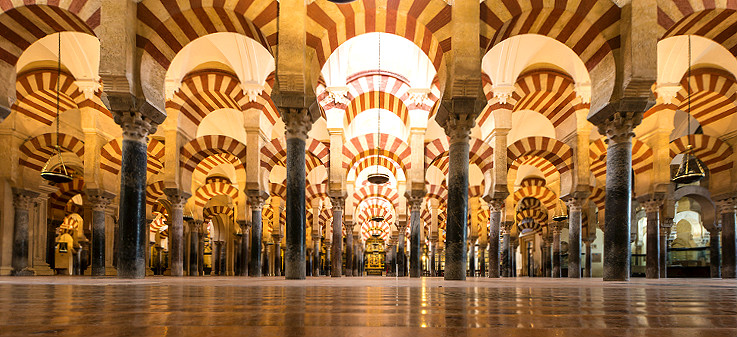
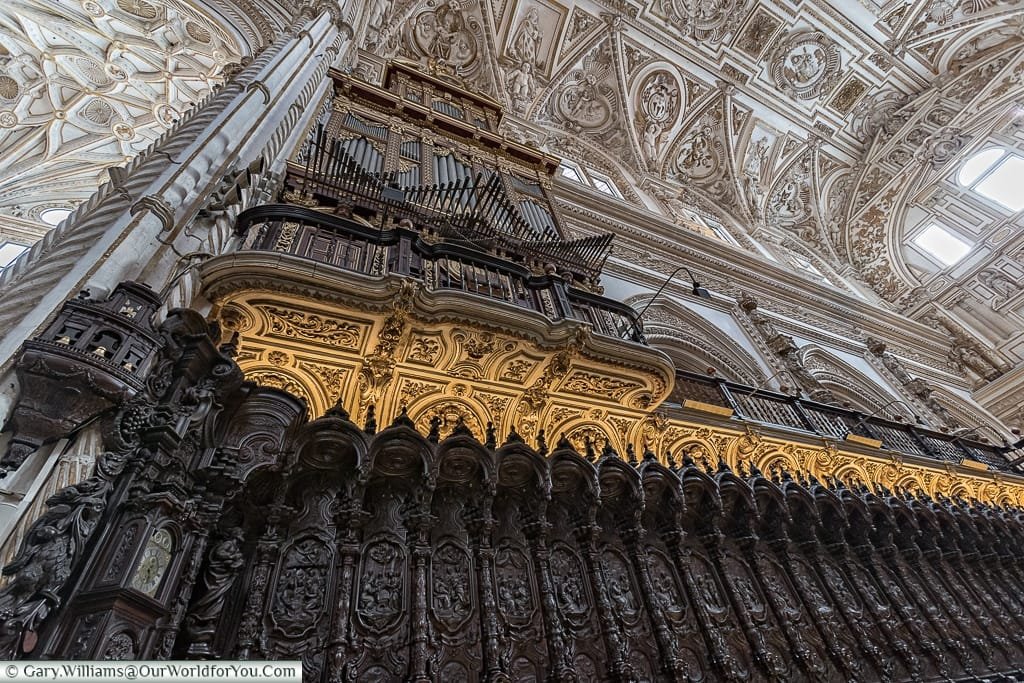
We literally had 36 hours to explore the city and so we did our best; we got lost in the Jewish Quarter several times; visited the Royal Palace and it’s beautiful gardens; explored the 12 patios of Viana Palace (a house that was inhabited by various families up to recent years); wondered at the remaining pillars of the Roman palace; wandered across the Roman river bridge and walked the edge of the city walls. However what really took our breath away was the Mezquita, originally a Mosque that was extended several times before being taken over by the Christians who added a superb Cathedral right in the middle of it. The architecture was stunning, the difference in builders over the years obvious and the eventual result is absolutely breahtaking.

We took a night tour of the Mezquita, which gave the building an eerie atmosphere but brilliantly showed off the sheer size of the building and showed what can be done with imagination and money. Originally built in the 8th century to accommodate people for prayer, it was extended three more times to finally accommodate 24,000 square meters containing 856 columns made of marble, granite, jasper and other materials. Then in 1236 Cordoba was recaptured by King Ferdinand III who rejoined Christendom and the mosque became used as church. Within the Mezquita’s centre, a Renaissance cathedral was built by Bishop Alonso Manrique in 1523. The new cathedral’s construction lasted until the beginning of the 17th century resulting in a remarkable and dazzling symbol of fine Moorish architecture.

City Walls & Jewish Quarter

Roman RemainsThe Alcazar (Palace) of the Christian Kings

Mosaics found on the Chapel walls

View of the River and Roman BridgeMezquita Walls & At Night

Inside the Mezquita

Image result for cordoba mezquita

Image result for cordoba mezquita

Image result for cordoba mezquita

Image result for cordoba mezquita

Related image

Image result for cordoba mezquita

Image result for cordoba mezquita

Image result for cordoba mezquita

Patios Open to the Public

The Viana Palace

‘,

Rio Tinto & Bella Vista

We took a drive north to a fascinating mining museum said to be the oldest in the world and spent the whole day exploring the mine and the area affected by it. The sheer size of the area mined was unimagineable; the ravaged and unrepairable landscape was shocking; the history and technology was fascinating but the overall image was of devastation, despite it once being a thriving community and business. We can honestly say this was an awe inspiring place, eerie and shocking, sad yet beautiful, colourful and yet disasterous.

We first visited the Museum (originally the former hospital of the Rio Tinto Company and built in 1927) now housing information and exhibits that showed that mining had been carried out in the area since the copper age (5000 years ago), through the bronze age, iron age and finally the roman age where there is evidence of the first period of industrialisation. The British arrival in the late 1870s brought a massive step forward in production and technology, as well as a creation of a town to house its workers right up to the 1960s.

In the museum is a Type N crane, unique in Spain, manufactured in 1930, it was used to help in derailments and accidents on the railway. Also on display is a Tyke K Locomotive, manufactured in 1908 by the North British Locomotive and one of 142 steam engines originally owned by the Rio Tinto Company, all imported by the British. The carriage behind was called The Maharajah’s Carriage, built in 1892 for Queen Victoria’s trip to India and brought to Rio Tinto for a visit by King Alphonso XIII.

The area is rich in sulphide deposits, created by a massive under ocean volcanic eruption 300 million years ago. Silver, copper and sulphur were mined through to the early 19th century by very rustic methods (men, pick axes and donkeys) resulting in little output, many accidents and the lack of efficient transportation meant the ores would reach Seville by donkey and wagon some 5 days later, therefore making little profit for the company running it at the time. From 1883 through to 1953 the Rio Tinto Company was created by two British mining companies and took over production and extraction flourished; they introduced open cast mining, improving pillars and supports to underground tunnels and created a railway line to the port of Huelva which was only a 5 hour journey.

The Rio Tinto river seeps through permeable rocks to fill the open casts; the colour of the water is a deep red, a result of 6 to 8 grams of heavy metals and sulphur per litre with a ph of 2.2. The water is poisonous, has no life other than micro organisms that have adapted to the minerals and metals in the water but has been found to be of health benefit to people suffering with skin conditions. The Rio Tinto was not polluted by the mining activities, it has always flown red and acidic into the Atlantic Ocean. At some points it turns yellow where river tributaries join and carrying different minerals this changes the water acidity for a while.

The area alongside part of the River has been used as a dumping ground for hundreds of thousands of tons of smelting slags, some solidified to the shape of the buckets it was dumped from.

The yellow soil alongside the river is created by unburned sulphur; in this mine iron pyrites are the most sulphurous in the world and the burning of the pyrites caused a dense fog of sulphur dioxide, thereby creating an acid rain which has subsequently changed the soil’s ph. Nothing will ever grow in this area again and the area resembles the surface of Mars; NASA has been studying the soil and trying to establish similarities between this landscape and that on Mars.

The train journey along 12km of track was littered with old houses and mills, Roman roads, steam machinery, signal boxes, remains of brick built hoppers, a cementation plant, mineral washing plants and several stations. The original 83 km line was built in two years, started at five different locations and linked together the mine to the port of Huelva, at a cost of £105 million pounds, in 1873 – 1875!! The line and its wooden carriages was also used by workers to travel to and from work in local towns and hamlets. At one point, 20,000 people were employed here, now it is just a tourist attraction.

Next we visited the Town called Bella Vista created by the Rio Tinto Company in the 1880s; a manager decided that he needed to house his workers nearby and built firstly a row of houses in a smart area, then followed a small village, all overlooking an area of woodland and rolling scenery. Part of the community included leisure facilities, such as a cricket green and pavilion, tennis courts, swimming pool, church and a school. Read the description (and translation) outside the church!!! As you enter the village you immediately see a row of very British houses and one (no 21) remains as a museum, showing how the middle manager and his family woud have lived.

Lastly, we visited an actual open cast mine, last mined in 1960 but originally dug by the Romans. We accessed the edge of the mine through a 200m tunnel where we saw the original access tunnel leading down to shafts where the ores were extracted, an emergency exit (wooden ladder) in case the lift wasn’t working, and chimneys where the steam from the locomotives used to transport minerals escaped. The ceiling was reinforced by beams of eucalyptus and pine (woods that are flexible and creak when they’re about to break, warning the miners before the tunnel collapses). The cast itself is 50m from the top to the water level, 150m wide and 350m long, with a depth of 35m. The colour of the water was a deep blue with a red tinge and the colours on the edges of the walls were red, yellow, purple, grey and white, showing all the different minerals that still bleed through.

‘,

« Older posts Newer posts »