Travel stories of a caravan duo, plus a 5th Wheel and Isuzu truck in Europe

Category: Spain (Page 8 of 16)

Ponferrada Wine & Rain!

Coastal or inland, the rain in Spain falls mainly on the Strattons and not on the plain!!! I know as a Brit we should not complain about the weather, but it truly has been terrible so I feel I have cause to complain! We came to Spain expecting better weather but for three months between January to April we had heavy rain in the Cadiz area. In April it sparked up and the sun came back, but May and June???? More rain. I have been considering renting a sun lamp to stop me losing my colour and purchasing some wellies!!!

Days out have been limited, but we have still got around. After we headed to the very north coast to see an area called Valdovino (and A Coruna), then moved back inland to an area recommended to us called Ponferrada, then back up the the coast but further east.

Ponferrada campsite turned out to be about 10kms away; a lovely level field that looks great on the website – running stream with a small “beach”, restaurant, bar, pool, kids play area, bungalows etc. In reality the field was a boggy (not their fault I know) open area with little character. The bar and restaurant had been closed for months, the pool had been sectioned off after being shut down by the local council, the edges of the site were cordoned off so the river was out of bounds, no washing machine (eekkkk!)…..so let me summarise: a field, with power nearby……..oh yes and hot water in the showers 🙂 So we thought, no facilities (even the local bar and hotel/restaurant had closed down) means cheap rates. No such luck. This turned out to be the most expensive site ever!!! 3 nights for the price of 5 or 7 at other sites. Still, a lesson learned – check prices first!!

Enjoying some peace one hour or so when it was not raining!

One particularly rainy Friday afternoon, in between the downpours, we decided to take a drive out for (a) some fresh air and (b) if possible to find some some fresh bread. We found the local village, which had a pharmacy, a school, two bars and council offices but no supermarket or open bakery. We took a left turn and just drove, and came to a vineyard with a pear orchard attached and a shed, a large shed. There was a board outside, telling you the history of the Fernandez family and their vineyards, some of them are over 100 years old but the family only purchased them from local farmers in the 1980s. As we were reading that opening times were seasonal and visits had to be pre-booked, the owner came out and started talking to us, eventually asking if we wanted to take a look around. Did we??? Silly question:)

So we had a private guided tour of the distillery, tasted a few whites and reds direct from the barrels and ended up buying half a dozen bottles from his very fine cellar. He explained that the geography of the basin his 120 vineyards were in were producing fruits that in the past 30 years have overtaken French wines in awards and purchasing quantities and he has received a lot of attention from international purchasers!! His secret? The grapes from different mountainside levels are kept together and not mixed or blended. BUT most importantly, he removes the stems from the grapes and adds the WHOLE grapes to a steel vat for 7 days before crushing them with a giant potato masher type device, allowing fermentation to take place. No foot crushing in these giant vats, the men would drown! He claims that by leaving them to ferment for 7 days before breaking the skins creates another layer to the taste, and we had to agree!

Turns out this is a great wine and Sidre (cider) making area, the local wine is called Bierzo and his particular vineyard is called Bodega Casar de Burbia. Isidro Fernández Bello is the owner, his website shows a great picture of him, just as we saw him!!! Picture below shows Isidro on the left, Nemesio (father, in the middle) and his wife who does the artwork on his labels.

Contact-Casar-de-Burbia

Oak barrels storing the new wine.

These are the steel vats used before the wine is crushed and placed in oak barrels.

Isidro sharing some new white wine with us.

Would you like to try some new red wine?


This batch will be ready in 2 or 3 years time.

The smallest bottling factory we have ever seen!

Ponferrada has a fantastic fort/castle/museum which we dashed out to on Saturday morning before the rain returned. We met several “pilgrims” heading to Santiago de Compostelo, one particular Frenchman engaged in a conversation about “you English love your history and do it well”. Thanks! There is also a Museum of Radio and a Steam Railway museum, which we didn’t get to due to the arrival of torrential rain. We were surprised to see a fairly modern neat town from the castle but had not worked out when it was built. Some properties around the castle were traditionally tall with slate roof tiles and balconies. So below are some great pictures of the castle.


‘,

The Glass City of A Coruña

It was recommended that we visited this City, and I can see why….as you have probably gathered, we have a fascination with buildings, their style, age and decor. We were in our element here, as the facades were stunningly elaborate.

According to tradition, the city was founded by Hercules in Phoenician times, it became a Roman fishing port, was taken over by the Romans, the Moors and taken back by the Spanish. Phillip II dispatched the Spanish Armada from here to attack the British in 1588, they were defeated, however, the Spanish Armada did defeat the army of Sir Francis Drake later. The population and economy improved and the city soon became a thriving fishing location, a port and a centre for clothing manufacture (Zara fashion clothing company was created here).

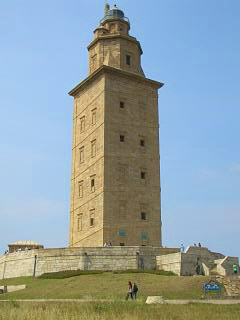
Hercules Tower (Lighthouse)

It was a rainy day when we visited, so we stuck to a few of the main attractions: the Tower of Hercules (light house); the castle (now an archeological museum) and the main square surrounded by the Palace and church.

The legend is that Hercules defeated a giant (King of local areas) called Gerion; he buried Gerions head and built a tower on top, founding the city nearby which he named Crunia. When Hercules left, his nephew finished the tower and furnished it with a lamp with fire that was never allowed to go out, placing a large mirror nearby through which enemy ships could be seen.

The original lighthouse was built by the Romans in the first century, the remains of which lay in the basement; also on display was the original stone which held the oil originally used to warn sailors of the rocks below. The building was rebuilt several times, the last major upgrade was in 1788 when an outer wall was added encasing the Chambers inside, making it the Oldest Active Lighthouse in the World. We climbed the 245 steps to the top and despite the drizzle, the view over the town, the coast and the Port was interesting.

 The tower of Hercules

The lighthouse stands on an elevated headland a short distance from the center of A Coruna city, facing the Atlantic Ocean and standing approximately 57 metres (over 180 feet) high.
The two people in the photo to the right give an indication as to the towers enormous size.

Modern Day Hercules!

The Castelo De San Anton (Archeological & Historical Museum)

On the site of the current castle, a chapel was built that was used to quarantine those arriving into the port with “the Fire of San Anton” disease, the chapel was later dedicated to this saint. The building was started in 1588 by King Philippe II and finally completed in 1776 when the Governors house was added to the top floor, and the building then became an active barracks, then a prison right up to 1958 when it was taken over by the local council and turned into the museum that it is today. The irregular shaped building is relatively small but houses interesting artifacts from around the area, including Roman coins and jewellery, a selection of pistols and rifles from 1800s and swords and other items rescued from the sea.

The water storage vault was interesting, water dripped into a storage tank from the stones above, to be used throughout the castle. Not sure I would have drunk it!!

A model of the castle.

View towards the mouth of the port.

View towards the city, the white building is a hospital. Downstairs is the old parade ground.

The water storage tank.

The Governor’s Chapel.

The old fireplace in the kitchen, items in front are old cannon balls.

Galerias

A galeria is nothing more than a balcony, but one that is enclosed in a glass frame protecting it from Galicia’s cool winters and making it usable all year round. Galerias can appear at first floor level, or on the six floor of a six storey building and there are many variances on the basic design.

Galerias are so prevalent and significant in A Coruna for two reasons – firstly, unlike Galicia’s other provincial capitols, a large part of the city is “modernist” and was built in the late nineteenth and early twentieth centuries – the galeria design was especially popular during this period. Secondly, the original fisherman’s houses (that lined the harbour and port) were built with galerias and subsequent structures that replaced, or were added to them continued this style.

The harbour front area of “Marina Avenue” is often called the “glass city” or “crystal city”. This is the spot where the original fishermen’s houses were, but today most of this area contains multi-storey offices and apartment blocks all of which are “loaded” with galerias. On a clear day, when the sun faces the harbour front during the evening, the reflection can be blinding and provides an impressive spectacle.

Maria Pita Square has standard shop and business premises at ground level but every possible style of galeria above. The whole area has a feel and atmosphere that is totally different to anywhere else we have visited in Galicia. At first many of the galerias appear very similar to one another, but on a closer look, subtle differences are obvious. Many buildings alternate two or three levels of galeria with an open balcony, or place the galerias only the top floors of the building, some have intricate detailing at sill level, whilst others are supported on ornate sculptured masonry or wrought ironwork – there is no fixed style.

The marina front.

Leading to the Maria Pita Plaza


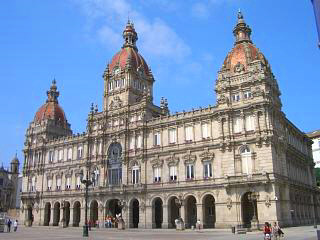
Maria Pita Square, Palacio Municipal & Church de San Jorge

The square is named after Maria Pita, a local who gained notoriety as a heroine by helping reduce casualties when Sir Francis Drake’s attacked A Coruna in 1589 – the square gives the impression that you are walking into a Royal court. The Palacio Municipal in A Coruna city This impression is further enhanced by the Town Hall and Council building (Palacio Municipal) which is truly monumental in both its scale and incredibly ornate detailing, the three domed towers at its front are topped with what appears to be bronze making it glisten in the sun. This building also has a long colonnaded archway along its main frontage and it completely dominates the large square. Its appearance suggests it is an old building, it was actually built in the early 20th century and is less than 100 years old.

San Jorge Church was a return to the opulence seen in most Spanish churches, it was beautiful, still, calm and smelling of lilies and polish.


 ‘,

Valdovino’s Beautiful Beaches & Colourful Cottages

We have moved to the north coast of Galicia and stopped for a few days at this small village on the coast. This is surfer’s paradise, the numerous river inlets where they meet the Atlantic forms beautiful endless sweeping beaches, some backed by sand dunes, some with rocky outcrops and fabulous rock pools and formations. The village also has a natural fresh water lagoon, formed by sand deposits, home to wild migrating birds.

The weather has not been great during our stay, it has rained constantly, only letting up in the late afternoon.

The village has a very modern lighthouse on the top of a cliff, built in 1992 as the last ever lighthouse built in Galicia, it is operated by remote control and the lamps are modern LED and halogen.

We also found some old look out posts, underground tunnels and storage areas which were once used during the wars to protect this coastline. There is a small chapel, accessible only in low tide, dedicated to the local fishermen, who lost lives when they fish or collect (by hand) barnacles found on this north coast, called swan necked barnacles, apparently a delicacy in restaurants!!

Also in this area, they do not have any issues with painting their Swiss style properties in a bright or pastel colour! They also have these odd buildings in their gardens; we have found out that they are called “Horreos” and are now a protected building, they were originally grain stores built in stone, on stilts or raised on a platform, with ventilation slats, topped with a concrete or tiled roof. Often they are painted to match the house colour.

Colourful Houses, Pink is popular!

‘,

Hot Tub City of Ourense

We took an overnight stop in the City of Ourense, home to half a dozen natural thermal springs, first “claimed as medicinal” by the Romans, who named the city Auria.

The city stands on a hillside, made up of a large modern shopping and a University, the medieval centre with its Cathedral and its old Roman bridge and then its all surrounded by large hotels, small restaurants and tavernas, all neatly fitted together. If you looked at some of buildings in the Plazas, surrounded by enclosed balconies, you could be forgiven for thinking you were in York!

The main tourist attractions are the hot springs, as Ourense holds one of the greatest amount of geothermal water in Europe. There are several places called pozas, with or without entrance fee (only €5 each to include showers, shower gel and privacy from the public) where you can have a bath outdoors. One of them is located inside the old town as per the ancient Roman tradition, as ruins of a Roman bath were discovered and are now open to visitors. There are several more hot springs located along the river Miño where baths are at different temperatures, ranging from 35 – 70 degrees Celsius. We spent one day in the city and the next at the spas!

13th Century Romanesque & Gothic Cathedral & The City

This is the Burgas Spring, where the water comes out at 65C!! It was steaming when David decided to put his hand in it!!

The Burgas spring comes out into a pool in the City, this is open from 7am to 1am each day! And it’s free!!

Confirmation of the Burgas Spring info.


Outdoor Springs, free and open to everyone!

We went here but paid the €5 to be away from the prying eyes, had a float in mineral rich green water for a few hours, came away feeling so relaxed and our skin was soft as a baby’s bottom for days!! We could not take many photos as it seemed an invasion of people’s privacy!


Breakfast Options!!

‘,

Moving On Up To Oia, Spain

We moved to a beautiful part of the Spanish coast, facing the Atlantic, about 30 miles north of the Portuguese Border and stopped here for ten days. The site was so relaxing, our pitch was facing the sea and about 10 metres above the sea level, we spent so much time outside watching the rocks and rock pools appearing and disappearing, the mist rolling in and out, the sun setting and rising and just listening to the waves crashing into the rocks.

The site was layered in grassy stretches, and the site filled at the weekend with families enjoying the pool and the sea. We made friends with a lady who owned the most beautiful cat ever, a Bengal Tiger that cost her €800, he was 8 months old and loved to wander around on his lead. We visited a few local towns, Baiona and A Guarda and visited some historic sites, but most of our time was spent relaxing and watching the views, even late at night!

Site Pictures

View from the rocks of our trailer.

Some of the amazing rock pools.

Rock pool contents.

Sunset at the site.

Photo of the bay, taken about midnight.

Our view from inside the trailer.

Daily strokes with this fella!!!


Oia’s monastery, now left to the forces of nature.

Baiona (pronounced Bay-on-na)

This small seaside town is dominated by an old fort that has been renovated to accommodate a 4* hotel and restaurant, with a small narrow street area behind the main parade, full of old buildings, squares, churches and tavernas. The fort is open to the public and you can walk the whole length of its walls; it is the only place we have ever seen a safety notice!

We also met a very friendly seagull, who would not leave us alone….we had no food, yet it was happy for us to get within 3 feet of it before it flew away to the next stretch of wall to eye us up!

A Guarda (pronounced A Warr-da)

This small fishing town is home to the remains of an Iron Age settlement, right on the top of it’s mountain, overlooking the port below. The circular houses were built in stone and surrounded by a 2 layer security wall and only two entrances, with evidence of roads down to the port and river estuary. The area is fascinating, the museum was very interesting and whilst I was in there, got talking to a member of staff; he was strangely looking at a video and reading about Flag Fen boats (in Peterborough) so I told him that we lived there and introduced him to the information about Roman villages being found alongside the A14 expansion last year. He was so interested!! Talk about a small world!!

 ‘,

« Older posts Newer posts »