On Palm Sunday (25th March), we ventured into town and found a church nearest to us; we had heard that a procession takes places from each church in town to the local Basilica, luckily the first one was from the church nearest to us. We arrived early, having forgotten all about the clocks changing…..and was fascinated to witness an amazing spectacle. Never having been a religious person, we really didn’t know what it was all about until we started talking to people around us and were told that it was Palm Sunday, the start of the Santa Semana – Easter week, when all churches parade their Pasos (statue) through the town to the Station of Penitance (in the basilica) and back to their church. Subsequently the Basilica also parades its own …. We understand each church (or brotherhood) has its own colours and the outfits are to give anonimity… so we waited and watched.
First to arrive were children and adults in blue and white outfits that resembled the Klu Klux Clan, long flowing gowns, pointed hats and full face masks; next to arrive were two or three coach loads of brass bands, two different groups. They all happily mingled until at 4pm, three members of the Clan approached the Church doors and hammered on them. The doors swung open and over the next half an hour, out came two floats, the first with Jesus atop, and the next with Mary surrounded by candles. We gathered this is the normal order. The head of the church carries a huge coloured book (perhaps their bible??) and is surrounded by well dressed and (forces) service decorated church members, who walk behind the Jesus pasos and one brass band; next are the majority of the congregation and there were maybe 200 people; followed by the Mary pasos and the second brass band. The procession took up a whole street, maybe 500 metres long so if the first band was playing you could not hear it, you could only hear the second band and people clapping.

Asking for entry…
This procession winds its way through the streets of the town, each church’s procession takes a different route but all ultimately end up at the cathedral (called a Basilica here). They take the Pasos into the Basilica, followed by the church members (the band remain outside) then within 10 minutes they come back out and proceed to take a different route through the town back to their church. This procession eventually arrived back at home base at just after midnight having departed at 4pm!!! Members are adults and children, male and female, and are sometimes seen stopping for a snack or sweety break (discreetly under their mask), or for a quick chat with members of the public, but all were so disciplined and they kept in order and carried on. It must have been a long day for all involved.
We have since learned more…..the religious purpose of the procession is to take the sacred statues, usually one of the Christ depicted in one of the various stages of the Passion, and one of the grieving virgin, from where they live in their various churches and chapels to be blessed in the Cathedral. Each procession is organised by its own Hermandad (brotherhood), and the weeks celebrations are co-ordinated collectively. The oldest brotherhood in the area dates back to the 14th century, after a period of decline in the 19th century, the 20th saw a progressive revival and the fixing of many of the forms and traditions maintained today.
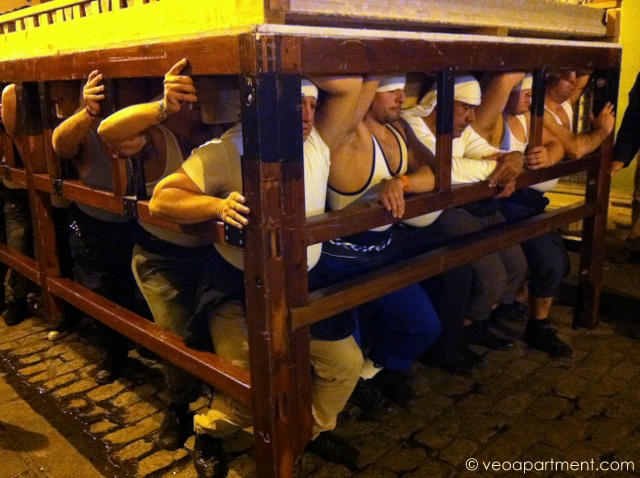
Costaleros at practice prior to Semana Santa
The statues are carried on floats known as “pasos”, by groups of men hidden underneath (these are called costaleros, they have towels on their heads and shoulders to protect them from the weight), whose movements are controlled by an overseer (capataz) by a system of coded knocks; the lifting and depositing of the pasos gives rise to a crowd hush and then applause. Both the pasos and the statues, some of which are important artworks in their own right, are always ornate and gilded, the virgins decked with flowers beneath a canopy, and the sight of them as they sway down the streets is surprisingly moving. To watch the changeover of Costaleros is quite a sight, swift, sweaty and yet serene.
They are accompanied on their journey by the Nazarenos and Penitentes (the ones in the cloaks and hoods, worn to preserve anonymity) carrying candles or crosses, various functionaries, and the brass bands who are responsible for the distinctive music that seems to be everywhere during this week.
So now for some photos to try to show you the incredible atmosphere and amazing floats.
The arrival of the band


 Opening of the church doors


 Exit the first Pasos


 And after 30 minutes, the second pasos, Mary


 Views of the procession through the town


The role of the man carrying the ladder is most important, he lifts the overhead cables out the way and relights the candles en route.


 Arrival at (and departure from) the Basilica


 Inside the Basilica, entry doors and their own Pasos on display:


 At night, the Pasos take on a different look, and smell! Candles and incence abound, as well as beer, food and people.


 A popular sustence along the route is fresh fried potato chips (crisps), very scrummy!
 Finally, our own sustenance – tapas and sherry!


 A popular sustence along the route is fresh fried potato chips (crisps), very scrummy!

 ‘,
‘,


Recent Comments