Travel stories of a caravan duo, plus a 5th Wheel and Isuzu truck in Europe

Category: Spain (Page 10 of 16)

Nature at Donana & El Rocio

When we booked ourselves onto a campsite halfway between Seville and Huelva on the coast, little did we know how remote the site would be. As we turned off a main road onto a potholed single width road, we headed 7km deeper and deeper into a forest, surrounded by nothing but pine trees, dirt tracks and even more endless vistas of pine trees.

The surrounding Donana National Park is a World Heritage Site, 100,000 hectares of salt marshes, scrubland, sand dunes and forest creating a mixture of lagoons, channels, beaches, marshes, wetlands and wooded pine forests. It’s home to hundreds of birds as well as lynx cats, deer and wild black hoofed pigs.

Eventually we came to what was classed as a “holiday village”, a small sandy campsite with touring pitches, bungalows and tents, perfect for parents who wanted a quiet natural break away whilst the children were kept busy in the play areas, sand pits and swimming pools. However, the only downside to this tropical paradise was that any activity outside the “village” involved a minimum 40km drive, to the nearest supermarket, decent sized town or tourist activity! Lesson learned….quiet out of the way sites = increased fuel consumption and long days! The positive points were seeing children being children, playing safely with sand, water, nature and each other as well as hearing the nightly owls and looking up to see open clear dark starry skies.

The site is owned by a French company and managed by a lovely French couple who spoke good Spanish and English; they gave us lots of hints and helpful information about the Feria in Seville and other interesting places to visit. The pool area is ideal for children, I do confess to dipping my toes in there one very hot day!

The bar was pleasant on a balmy evening, until the mosquitos arrived!

Our pitch was very spacious with sun in the late afternoon and evening.

The nearest town south of us was a place called El Rocio and what an odd place this is. As you pull off the main road you immediately drive onto what you think is a sand based car park but there is sand everywhere you walk and look.

The impressive cool white church catches the eye, as does the sandy roads, no tarmac anywhere and more horses than cars! We immediately thought we were on a stage set for a western movie but quite quickly found that this little town was just that, a small town set on the edge of the sandy national park, surrounded by lakes and rivers, full of flamingos, herons, storks and other migratory birds and inhabited by horse riding locals. The few high street shops were full of either flamenco dresses or horsey equipment, bridles, chaps, clothing, hard hats and leather boots!

The town is also famous for its White Dove (or Our Lady of El Rocio) statue and hosts an annual pilgrimage when around Pentecost a million (yes, you read it right!!!) people descend on this tiny place to pay homage to the Queen of the Salt Marshes and attend a service in the beautiful church. The interior of the church could almost be called austere, plain white walls and columns and only a colourful, but not gaudy, alter piece. To the right of the church is a building that looks and smells like it has been involved in a fire; inside is row upon row of candle holders that all point to the statue of Our Lady at the front. The ceiling and walls are totally black, burned from centuries of candle smoke.

The local hostelries provide “horse bars”, wooden structures at horse height for the placement of cold glasses of cervesa and vino. Wooden tie posts adorn the front of most houses in place of garages or patios!

The main attraction in El Rocio is the wild life in the lakes; we saw spoonbills, flamingos, osprey and herons as well as ducks, geese and we think, an otter. There was also a Flamenco club taking a quick sup before a dance session, all the ladies were dressed the same!

Driving along the endless roads around the National Park we often saw signs for “deer crossing” or “Linces” as they are called in Spain. We were very disappointed as we didn’t get to see any…..so we have created our own!

‘,

Final days in Jerez area

By Wednesday 4th April 2018, we were the only vehicle in our area in the campsite, as our German neighbours had left to head home, the Belgians were leaving the day after us and the British were leaving next week. On Thursday, we moved to Seville, as part of the next leg in our travels. Before we left we had a few sessions of Boules, followed by drinks and tapas, of course!

Steve and Julie, Staf and Toni, Juliet and Susie, Leia and Hilda, Ian and David out of shot!

However before leaving, we spent a few days in Jerez, exploring areas that we have missed out on. Jerez is a large inland town, calm and chilled, full of history and culture, home to the most sherry Bodegas in the south of Spain. As you know, we have visited several and can now say we are fully conversant in the language of Sherry!!

Several times we have missed out on visiting the Alcazar in Jerez, so we headed there one morning. Its a Moorish fort, dating back to the 11th and 12th century, and declared a site of Cultural Interest in 1931. The quadrangle walls are almost 4000 metres long, half of which can be walked along, the octagonal Tower in the fort is still in excellent condition and an ornate 14th Century tower that has been annexed is fully intact. The mosque in the grounds is the only remaining mosque of eighteen originally in the city, and its minaret was turned into a bell tower following its conversion to a church in the 1200’s. The Palace building dates back to the 12th century and retains its original leisure pavilion. Remains of Roman baths can be seen and visited, they include an entrance area, the cold and tepid rooms, and the hot room, whose heating system is still partially visible. The system is linked outside to a water wheel, water storage area, bakery and water distribution system. They also have the remnants of an oil processing mill on site, showing how the massive beam was used to crush olives to a storage still below.

Spring is springing in the Alcazar gardens.

View of the Palace, the quadrangle, and the Tower.

View of one of the towers from the wall.

The explanation of the workings of the oil mill.

The huge oil mill beam.

View from inside the Roman baths looking up to the steam vents in the hot area.

Looking down onto the domed roofs of the Baths, Palace in the background.

The baths to the right, water wheel with storage system bottom left, and top left was the bakery ovens.

External view of the mosque and its bell tower.

Inside the Palace are rooms displaying posters and paintings and on the top floor is an old chemist or apothecary. Jerez is full or amazing old buildings in so many different styles, one that caught our eye was the train station.

We came across this Irish pub tucked away in a courtyard…..needless to say it was full of Spanish people drinking beer and sherry, not Guinness! We have also been out and about to other towns, and seen some beautiful beaches and buildings, Cadiz being one of them.

A little further up the coast was Chipiona, a seaside town with amazing beaches.

We have seen some fabulous fruit and veg along the way….

And seen some amazing beaches, in good weather and bad.

David has finally “caught” a fish!

That’s what you call “a log and a half” !!

 ‘,

Flamenco passion!

I have waited until now to write about Flamenco, the expressive dance made famous by the Andalucian gypsies in the south of Spain. The uninitiated would usually associate Flamenco with a lady dancing in a frilly red dress, but there is much more to it than that. The dance, songs, rythym and music goes a long way back, the songs and music are the way the people express their love, happiness, despair, sadness and tales of life with personal interpretation applied through the dance. Generic moves are taught to young children but each dance is different depending on the story attached to it.

We have visited several tabancos (rough bars with impromptu flamenco singers) and tavernas (bars serving food where locals burst into song and dance) as well as been to several organised tourist aimed shows and have to say that it really is worth experiencing at least once in your lifetime.

The experience is so intense that it leaves you with a sensation similar to a headache, but it’s a pleasant and happy headache that makes you think “wow!!”. Your feet and hands start to automatically tap along with the guitar rythym and you clap along with the singer, and stare, trying not to blink in case you miss something, at the amazing steps performed by the dancers. The lady dancers are so intense in their passion, performing foot tapping routines so quick that you wonder if their heels are actually moving. The male dancers are so tight and pert (both in body and style) that you can see the muscles moving with each step they make, again with passion and a concentration that is shockingly amazing.

Sadly we could not take photos or videos at the shows we went to so I cannot try to show you this passion, the next few photos may portray the passion involved. The first photos were taken in a small packed tabanco in Jerez, where a singer and a guitarist were performing.

‘,

Santa Semana in Jerez

We decided to visit Jerez during the Santa Semana week, to witness the same procession but on a bigger scale. The only bigger scale was the amount of people watching the procession, and the amount of people in each procession from the brotherhood, the Pasos were almost the same as was the order of the procession, the bands and the outfits.

The noise was much louder, children with drums, trumpets and whistles, adults shouting to attendees in the procession but also regular traffic in the town – the route was not marked or secured off as it would be in the UK, scooters were allowed down the same roads as the procession; businesses were open as usual and people shopped, drunk coffee and went about as normal, very strange! Health and safety in the UK would have had a field day!!

So a small selection of photos follow of our day in Jerez.

 ‘,

Santa Semana (Easter week) in El Puerto de Santa Maria

On Palm Sunday (25th March), we ventured into town and found a church nearest to us; we had heard that a procession takes places from each church in town to the local Basilica, luckily the first one was from the church nearest to us. We arrived early, having forgotten all about the clocks changing…..and was fascinated to witness an amazing spectacle. Never having been a religious person, we really didn’t know what it was all about until we started talking to people around us and were told that it was Palm Sunday, the start of the Santa Semana – Easter week, when all churches parade their Pasos (statue) through the town to the Station of Penitance (in the basilica) and back to their church. Subsequently the Basilica also parades its own …. We understand each church (or brotherhood) has its own colours and the outfits are to give anonimity… so we waited and watched.

First to arrive were children and adults in blue and white outfits that resembled the Klu Klux Clan, long flowing gowns, pointed hats and full face masks; next to arrive were two or three coach loads of brass bands, two different groups. They all happily mingled until at 4pm, three members of the Clan approached the Church doors and hammered on them. The doors swung open and over the next half an hour, out came two floats, the first with Jesus atop, and the next with Mary surrounded by candles. We gathered this is the normal order. The head of the church carries a huge coloured book (perhaps their bible??) and is surrounded by well dressed and (forces) service decorated church members, who walk behind the Jesus pasos and one brass band; next are the majority of the congregation and there were maybe 200 people; followed by the Mary pasos and the second brass band. The procession took up a whole street, maybe 500 metres long so if the first band was playing you could not hear it, you could only hear the second band and people clapping.

Asking for entry…

This procession winds its way through the streets of the town, each church’s procession takes a different route but all ultimately end up at the cathedral (called a Basilica here). They take the Pasos into the Basilica, followed by the church members (the band remain outside) then within 10 minutes they come back out and proceed to take a different route through the town back to their church. This procession eventually arrived back at home base at just after midnight having departed at 4pm!!! Members are adults and children, male and female, and are sometimes seen stopping for a snack or sweety break (discreetly under their mask), or for a quick chat with members of the public, but all were so disciplined and they kept in order and carried on. It must have been a long day for all involved.

We have since learned more…..the religious purpose of the procession is to take the sacred statues, usually one of the Christ depicted in one of the various stages of the Passion, and one of the grieving virgin, from where they “live” in their various churches and chapels to be blessed in the Cathedral. Each procession is organised by its own Hermandad (brotherhood), and the week’s celebrations are co-ordinated collectively. The oldest brotherhood in the area dates back to the 14th century, after a period of decline in the 19th century, the 20th saw a progressive revival and the fixing of many of the forms and traditions maintained today.

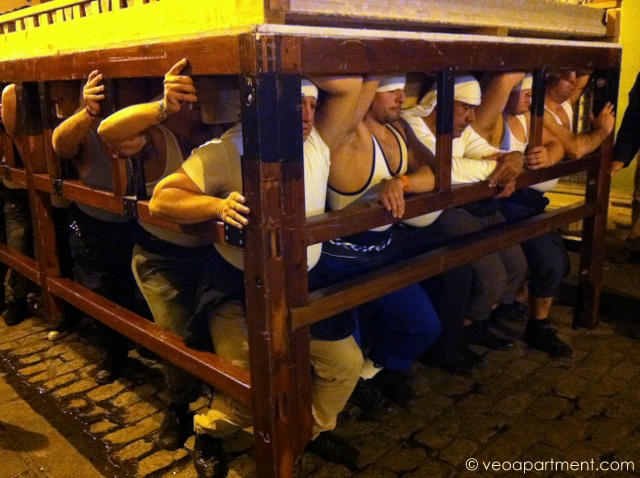
costaleros at practice prior to Semana Santa

Costaleros at practice prior to Semana Santa

The statues are carried on floats known as “pasos”, by groups of men hidden underneath (these are called costaleros, they have towels on their heads and shoulders to protect them from the weight), whose movements are controlled by an overseer (capataz) by a system of coded knocks; the lifting and depositing of the pasos gives rise to a crowd hush and then applause. Both the pasos and the statues, some of which are important artworks in their own right, are always ornate and gilded, the virgins decked with flowers beneath a canopy, and the sight of them as they sway down the streets is surprisingly moving. To watch the changeover of Costaleros is quite a sight, swift, sweaty and yet serene.

They are accompanied on their journey by the Nazarenos and Penitentes (the ones in the cloaks and hoods, worn to preserve anonymity) carrying candles or crosses, various functionaries, and the brass bands who are responsible for the distinctive music that seems to be everywhere during this week.

So now for some photos to try to show you the incredible atmosphere and amazing floats.

The arrival of the band

Opening of the church doors

Exit the first Pasos

And after 30 minutes, the second pasos, Mary

Views of the procession through the town

The role of the man carrying the ladder is most important, he lifts the overhead cables out the way and relights the candles en route.

Arrival at (and departure from) the Basilica

Inside the Basilica, entry doors and their own Pasos on display:

At night, the Pasos take on a different look, and smell! Candles and incence abound, as well as beer, food and people.

A popular sustence along the route is fresh fried potato chips (crisps), very scrummy!Finally, our own sustenance – tapas and sherry!

‘,

« Older posts Newer posts »